Seven whole years! Well, this last year was more like... a third of a year, by the output. But I'm still here and still thinking about writing about what I read. The days somehow seem shorter and the time is going faster, and I get neither as much reading nor anywhere close to as much writing done as I'd like to.
I'm hoping to at least participate in Long Awaited Reads month, in what ever form that takes this year - I've got both Aldo Leopold's Sand County Almanac and Italo Calvino's If on a winter's night a traveller sitting ready to go. I've been reading widely, trying to keep up with my book club at work; I've started A Reunion of Ghosts by Judith Clare Mitchell for our February meeting already, which is way out of my normal reading way, but I'm cautiously optimistic that I'll get through it. Although I have been not-finishing a lot more than I used to not-finish too. I think if I can try to take notes on and write here about the book club books I'll lead a better discussion; that's how it seems to work, usually.
So yes. You can be forgiven for wondering if anything was happening here at all lately. But it's been happening for seven years. Can't stop now!
Thanks for reading, if you do, and wishing you all a happy holiday season and a new year full of good people and good books!
Saturday, December 26, 2015

Thursday, December 10, 2015
Kiss of Steel by Bec McMaster
 Kiss of Steel
by Bec McMaster
Sourcebooks Casablanca, 2012
423 pages
Let me talk about the benefits of proper world-building in science fiction and fantasy.
So in case you were thinking I've gone all Canliterary, with my Humphreys and my Thuy, I shall now discuss my most recent read, which was Kiss of Steel by Australian paranormal romance author Bec McMaster. I'm going to be honest: I picked it almost as a joke, because - well, look at that cover. Right? What is Honoria even wearing. And I know that authors don't always (very rarely?) get a lot of say in their covers, and frankly this is not the worst of the romance covers out there (so very not) and it obviously did its job. I wanted something over-the-top and steampunkish. I downloaded the eBook. I started reading it.
And damned if it wasn't actually quite good.
Soapbox time: one of my biggest problems with fantasy or sci-fi (or in this case, steampunk) in the Romance genre in general is sloppy world-building. I've just recently become familiar with the term "wallpaper historical" to describe [some of my favourite] historical fiction and it is exactly appropriate. And if "wallpaper sff" isn't a term it should be - the trappings can be there, the magic and/or the spaceships - but a lot of the time the world-building in books that are Romance first and sff second is hasty and extremely cliched. This always kind of breaks my heart because I happen to really love my fantasy with a strong romantic component. But it has so rarely worked the other way for me that I've kind of given up.
The problem for me is that I am extremely familiar with the fantasy genre. I grew up with it. It's in my blood right there with my haemoglobin. So I know when an author is just wallpapering over their books with fantasy cliches - they may be well-intentioned, they may even have a true fantasy story in mind - but dammit, pay attention to your world. If you have a Chosen heroine and a banished berserker hero, I want to know why she was Chosen and what for, I want to know about berserker culture, and I for sure don't want an Evil Mage arch-bad-guy. That's been done, and better than most people can do it. Your characters need to be a product of their environment, not the other way around.
Steampunk, in my limited experience, can be a bit better at this - generally people who are writing steampunk are totally in love with their own worlds, fascinated by the ideas and the intersections of human stories and technology and history. Maybe it's too newly popular a genre to have spawned the same wealth of cliches that fantasy and science fiction have, forcing people to come up with their own ideas and explanations, not allowing them to use shorthand.
Whatever the reason, McMaster has done it well. She doesn't do everything well. There was a bit too much repetition - I don't need to be reminded, all the time, that Honoria grew up in the hallowed halls of the Echelon, or that Blade killed his own sister. I got it the first two or three times. Also I actually really wanted more of Honoria teaching Blade how to read - that particular plot contrivance vanished, never to be seen again, after the scene where it first appeared. There are times when things go on a bit longer than they should.
But the setting... McMaster's London is gritty, ugly, violent, and sometimes beautiful, and it makes sense. And Honoria and Blade and the rest of the characters make sense in the world. They've come out of it. This story wouldn't make sense anywhere else. And that, as much as anything else McMaster has done, makes this book worth the read.
Setting/world-building isn't everything, to be clear. McMaster also has a good handle on the English language and uses it to her advantage; the prose is clear, quick, and supports the wonderful descriptions; the characters are entertaining and consistent; the plot is dramatic and clever, if a bit packed.
The key here is that this book is a romance novel first and foremost. Even with the detail and depth of the world and the politics, this is essentially a book about two people finding each other, falling hard for each other, surmounting some critical obstacles, both internal and external (and the external ones come straight out of the world they live in), having some sex, and getting a happy ending. (Not uncomplicated happy. But happy.) Which means that it's got to be possible for someone out there to do the same thing with fantasy, too.
Honoria Todd and her two siblings have fallen on very hard times, since her scientist father was murdered and a price put on her head by the villainous but politically well-heeled Vickers, a duke and leader of one of the seven ruling houses. Vickers and all the other rulers of London are blue bloods - humans who have been infected with the craving virus. Yes, it makes them drink blood to survive, heal quickly, have incredible strength and agility. It also happens that Blade, the Devil of Whitechapel, ruler of the most powerful gang in the city outside the city, is a rogue blue blood - he was pulled out of the gutter, infected, and enslaved. But Blade escaped. He knows who Honoria is, and he's going to use her to get at Vickers; she needs his protection to survive in the extremely dangerous slums. Cue the romantic tension as Blade discovers Honoria is more than she appears on the surface, and Honoria discovers that Blade isn't like the other blue bloods she's known.
Blue bloods are not vampires, exactly - vampires are blue bloods whose virus has finally run its course, who no longer have control over their urges, who hate sunlight. They are extremely dangerous predators. And when a blue blood is to the point where he's (they're all men, because of Victorian ideas of female fragility) about to start turning vampire (determined by blood tests) he's beheaded. That's always going to be the end game for a blue blood, eventually. And once infected, there is no cure.
What McMaster has done here is taken an idea - what if England was ruled by "vampires" - and spent a lot of time figuring out what the logical conclusions would be. Of course Victorian London would be home to "draining factories" where people go to pay their blood tax. (Of course taxes would be paid in literal blood.) Of course people who couldn't afford to eat would sell their blood to unscrupulous Drainers. Of course there would be roving gangs of Slashers, who pick the impoverished off the streets of the slums - or out of their own homes - at night and kill them, draining them of blood entirely for sale to the factories. Who of course wouldn't condone that sort of thing, but would pay for it quietly anyway.
And it's all like this - all the little details thought out. Everything comes from somewhere, and everything makes sense. And that means the characters make sense, and the story makes sense, and since it's written well and the plot is interesting and the characters have depth - well, there you have it. A read I enjoyed far more than I thought I would, for more reasons than I expected to.
Thursday, November 12, 2015
The River by Helen Humphreys
One of the things I'm going to have to do if I'm going to start updating again is be a little less rigid about how I update and when and for what. I used to go at this chronologically - that is, whatever I read first, I'd write about first. And I wrote about everything I read, regardless, except for the books I didn't finish. I have about 30 books I still need to write about, going all the way back to January of this year. I say "need" - but do I need to? Perhaps, at this point in my life and writing, the more appropriate criteria is "want" - which of these books that I have read do I most want to write about right now.
And right now, I want to write about The River.
 The River
by Helen Humphreys
ECW Press, 2015
224 pages
I have an odd reading relationship with the work of Canadian author Helen Humphreys, and this is yet another entry into that ongoing weirdness. (The weirdness is with me, not her books.) Previous to The River I have read The Frozen Thames and loved it, and The Lost Garden and wanted to love it but had trouble with the subject matter and the prickly main character, Gwen. Humphreys tackles subject matters and writes characters that I find uncomfortable, and yet - I keep going back. I don't usually do this with authors who write characters I find uncomfortable or books that make me sad.
I'm going to keep going back to her, too. There's no question. Even though I know what I'm getting into.
I do this for the writing. Helen Humphreys is a poet and she writes prose like a poet. This will get me every time. I like good writing. A book doesn't tend to make it with me without it, regardless of how excited I am about the characters or the plot or the concept. And apparently really beautiful writing will draw me in regardless of how unexcited I am about the characters or the plot. So despite the detachment Humphreys writes with, and the often melancholy (sometimes very melancholy, sometimes downright sad) tone, and despite characters who can be hard to love, I read Humphreys.
The River itself is as odd a piece as The Frozen Thames, a book that defies cataloguers to put it in a specific place on the shelves. Our library has decided it is a biography. Of... a river I guess? Because that is what it is - a word portrait of a river. In short passages, some a few pages and some a single line, Humphreys introduces the reader to Depot Creek, specifically to a little plot of land - her little plot of land - on the banks of said Creek. Using this as a jumping off point, we are introduced to the creek itself, the Napanee River, the town of Bellrock, the people who have used the river and inhabited the land where Humphreys lives now, the wildlife that use the river, and so on. In some cases she just describes something - the river, the history, a creature on the river - and in others she has written pieces from the perspective of someone who may have existed, or who did exist. These would be fiction, but they're still trying to do the same thing that the nonfiction descriptive passages are: get to the heart of what the river actually is, what it truly means.
It's lovely. It's melancholy. It's a unique gem of a book. It's also beautiful as a physical item; the photographs and drawings strategically placed through the pages are perfect. This is not one to e-read; you will be much happier if you can have it in your hands. Recommended for anyone who loves beautiful words and is interested in history, natural history, and the attempt to peer into the heart of something so prosaic and so unknowable as a river. I didn't love it, because it's not exactly a loveable book. It's a bit prickly, a bit detached. But I will remember it and I will come back to it.
And right now, I want to write about The River.

by Helen Humphreys
ECW Press, 2015
224 pages
I have an odd reading relationship with the work of Canadian author Helen Humphreys, and this is yet another entry into that ongoing weirdness. (The weirdness is with me, not her books.) Previous to The River I have read The Frozen Thames and loved it, and The Lost Garden and wanted to love it but had trouble with the subject matter and the prickly main character, Gwen. Humphreys tackles subject matters and writes characters that I find uncomfortable, and yet - I keep going back. I don't usually do this with authors who write characters I find uncomfortable or books that make me sad.
I'm going to keep going back to her, too. There's no question. Even though I know what I'm getting into.
I do this for the writing. Helen Humphreys is a poet and she writes prose like a poet. This will get me every time. I like good writing. A book doesn't tend to make it with me without it, regardless of how excited I am about the characters or the plot or the concept. And apparently really beautiful writing will draw me in regardless of how unexcited I am about the characters or the plot. So despite the detachment Humphreys writes with, and the often melancholy (sometimes very melancholy, sometimes downright sad) tone, and despite characters who can be hard to love, I read Humphreys.
The River itself is as odd a piece as The Frozen Thames, a book that defies cataloguers to put it in a specific place on the shelves. Our library has decided it is a biography. Of... a river I guess? Because that is what it is - a word portrait of a river. In short passages, some a few pages and some a single line, Humphreys introduces the reader to Depot Creek, specifically to a little plot of land - her little plot of land - on the banks of said Creek. Using this as a jumping off point, we are introduced to the creek itself, the Napanee River, the town of Bellrock, the people who have used the river and inhabited the land where Humphreys lives now, the wildlife that use the river, and so on. In some cases she just describes something - the river, the history, a creature on the river - and in others she has written pieces from the perspective of someone who may have existed, or who did exist. These would be fiction, but they're still trying to do the same thing that the nonfiction descriptive passages are: get to the heart of what the river actually is, what it truly means.
It's lovely. It's melancholy. It's a unique gem of a book. It's also beautiful as a physical item; the photographs and drawings strategically placed through the pages are perfect. This is not one to e-read; you will be much happier if you can have it in your hands. Recommended for anyone who loves beautiful words and is interested in history, natural history, and the attempt to peer into the heart of something so prosaic and so unknowable as a river. I didn't love it, because it's not exactly a loveable book. It's a bit prickly, a bit detached. But I will remember it and I will come back to it.
Saturday, October 31, 2015
two books by Kim Thúy

by Kim Thúy, translated by Sheila Fischmann
Random House Canada, 2012 (originally published in French in 2009)
141 pages
Mãn
by Kim Thúy, translated by Sheila Fischmann
Random House Canada, 2014 (originally published in French in 2013)
139 pages
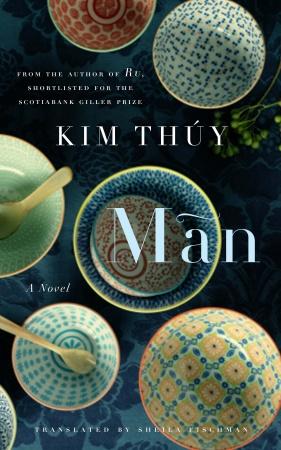 Here's a thing I don't do often: read a book, and then immediately go out and find whatever I can by the same author and read that too. I did it in this case. And the strange thing is that - I liked Ru. I respected Ru. I didn't think I'd loved it. But perhaps, in some way that my own brain didn't quite clue in to, I did? It helped, too, that Mãn had just come out very recently, and working in a library, I had it to hand immediately.
It's a little hard to hang on to either of these books in specifics, in that they don't have much in the way of characters or plot. But they do have imagery and tone, and somehow Kim Thúy has managed to make those the driving force of Ru, and to a lesser extent Mãn. The latter does have more plot, and significantly more character. This may or may not be a good thing; I liked them both, and originally thought of Mãn as being the stronger, and underrated. But it's Ru that has stuck with me more clearly. Both explore the life of a woman who has come from Vietnam, as a refugee (in Ru) or after the war (in Mãn). The war plays a large role in both these novels, as does the experience of coming to a new country - in this case, Canada - and making a life here.
One of the meanings for the word "ru" is lullaby - Thúy explains this at the beginning of the book. In many ways, Ru struck me as a series of images that might bubble up before sleep. Ru and Mãn don't even really have chapters; they have paragraphs, or sections. Sometimes a section is a line or two long. Sometimes it's three, maybe five pages. I'm not sure there were any sections longer than that. Each is a painstakingly crafted image, memory, or moment, from a first person perspective. The narrator can be a bit dry, or maybe a better way to describe her is "reserved," but one gets the impression that she is always trying to be honest. Some of the sections are connected. Some of them are not, other than they have the same narrator.
Both start fairly slowly, especially because (to me at least) the format can come as a bit of a shock. Because neither book is structured as a typical novel, and without the usual components like a solid, chronological plot or dialogue or conventional characterization to hang on to, one can feel a bit adrift for the first little while. I worried about this, when I started Ru, because it's not a long book. I needn't have worried.
The books - most especially Ru, but Mãn as well, to a lesser extent - unfold like a series of beautiful blossoms, each page or section a memory, hanging off each other like a delicate string of pearls. If you hold them lightly, something wonderful happens. The reader does a lot of the work, filling in blanks. Nothing is explicit. But gradually a picture begins to develop - of Vietnam, of the life of a "displaced" person, of how a person can break apart and slowly be put back together, but never again without scars. Mãn, with its more explicit plot, does a lot more of the work for the reader. Which means that though I think it's stronger in some ways - it gives one more to sink one's teeth into - it also imposes itself on the reader, where Ru almost feels like it comes from within.
Neither one of these books will take you very long to read. And both are worth it. But if you're going to read just one, read Ru. Be prepared to open yourself to it, no matter how slow or odd it seems at first, as a reading experience; you will be rewarded.
Tuesday, October 13, 2015
Fangirl by Rainbow Rowell
I have this little thing, called a blog? And I used to write about books? And then one day I just stopped.
And then one day I just started again. So here we go. Bear with me, I'm incredibly rusty.
 Fangirl
by Rainbow Rowell
St. Martin's Griffin, 2013
422 pages
Once upon a long time ago I read a book called Fangirl. It was one of the first books I read this year, in fact. And I loved it. The end.
No no, there's more - and I'm not going to do the book justice, of course, because I read it nearly a year ago, but here's the thing: I read this nearly a year ago, quite quickly, and I still think about it regularly and with a fair amount of clarity. The thing is, it's not just a nice book - and it is, a really nice book, where nice things happen and people are kind and awkward and lovely and maybe sometimes a bit mean but they aren't just awful for no reason. They all have reasons, and they are all sympathetic, even when they are not good reasons. There's no forced love triangle, there's no insta-love, there's no easy answers; there are just good people trying to work their way around being individuals and members of families and friends, which is not always easy and provides enough drama to make an engaging, charming, intelligent book.
More than just being a nice book, Rowell's writing makes the reading of it seem effortless. It's an easy read. It goes down smoothly. It's funny in the right parts, and tense in the right parts, and moving in the right parts. The pacing is absolutely dead on. I was worried that the excerpts from Cath's fanfic would stall things, or be uncomfortable to read (in the way that fiction-within-fiction can sometimes just be... weird) but those excerpts were delightful. I can see why people want to read more Simon Snow.
Me, I'll be reading more Rowell, regardless of whom she's writing about. Thoroughly enjoyed, highly recommended.
And then one day I just started again. So here we go. Bear with me, I'm incredibly rusty.

by Rainbow Rowell
St. Martin's Griffin, 2013
422 pages
Once upon a long time ago I read a book called Fangirl. It was one of the first books I read this year, in fact. And I loved it. The end.
No no, there's more - and I'm not going to do the book justice, of course, because I read it nearly a year ago, but here's the thing: I read this nearly a year ago, quite quickly, and I still think about it regularly and with a fair amount of clarity. The thing is, it's not just a nice book - and it is, a really nice book, where nice things happen and people are kind and awkward and lovely and maybe sometimes a bit mean but they aren't just awful for no reason. They all have reasons, and they are all sympathetic, even when they are not good reasons. There's no forced love triangle, there's no insta-love, there's no easy answers; there are just good people trying to work their way around being individuals and members of families and friends, which is not always easy and provides enough drama to make an engaging, charming, intelligent book.
More than just being a nice book, Rowell's writing makes the reading of it seem effortless. It's an easy read. It goes down smoothly. It's funny in the right parts, and tense in the right parts, and moving in the right parts. The pacing is absolutely dead on. I was worried that the excerpts from Cath's fanfic would stall things, or be uncomfortable to read (in the way that fiction-within-fiction can sometimes just be... weird) but those excerpts were delightful. I can see why people want to read more Simon Snow.
Me, I'll be reading more Rowell, regardless of whom she's writing about. Thoroughly enjoyed, highly recommended.
Subscribe to:
Posts (Atom)