Pages

Showing posts with label contemporary. Show all posts

Monday, January 1, 2018

Love in Lowercase by Francesc Miralles, translated by Julie Wark

English cover of Love in Lowercase by Francesc Miralles from Penguin Books (image from Goodreads)
Love in Lowercase
by Francesc Miralles, trans. Julie Wark
Penguin Books, 2016; original publication 2006
224 pages

I first heard about this book at the end of librarian Annie Spence's Dear Fahrenheit 451, which I could basically have read and called it work time. It's full of library shop talk, but anyone who loves books as objects would find something to enjoy about Spence's book. At the end, Spence puts together a series of reading suggestions - basically readers' advisory in book form, and I decided to try a couple of the books that she recommended.

I decided to try Love in Lowercase by Francesc Miralles, which has been described as a "Rosie Project-esqe" read. I wouldn't know, because I haven't read The Rosie Project, but lots of people seemed to like it, and Spence talked about how books, language, stories, and culture play a large role in Love in Lowercase, on top of it being a romance. Usually my sort of thing. Once started, though, this had more of a Paulo Coehlo-esque feeling for me, which - not my sort of thing. But there was enough to it, and it read easily enough, for me to keep going, and it's not very long.

It is a romance, but unlike my usual feelings about romance in books (which can be boiled down to "more please") I hardly cared what happened to this one. At the most it was a catalyst to get Simon, bachelor professor of German at a university in Barcelona, to get out of his comfortable routine. It was one of those insta-love (though with a small twist) things that seem so far-fetched that it stretches even my incredibly stretchy suspension of disbelief, and Gabriela doesn't quite get fleshed out enough to make sense, though - as I think about it, I suspect that's at least a little on purpose, because Simon doesn't know her at all either, despite being wildly in love with her. She puts up with it very well.

More interesting to me was Simon himself, on his own. As the book begins he's a very crabby young-ish man who has a comfortable life: he's a professor, who teaches his classes, feeds himself, occasionally goes out for a drink or a walk on his own, likes classical music and film, and generally has a very low opinion of the rest of humanity. But at the same time, he misses human connection, and he almost knows it; he spends New Year's Eve panicking about his own mortality, but he doesn't seem to realize that what's missing is relationships that mean something to him. Enter the cat.

Simon doesn't like cats, of course; he thinks they're dirty, but out of some sort of soft, human impulse, he puts a saucer of milk out for an orange tabby that shows up at his door on New Year's Day, and suddenly things start to happen. Coincidence leads to coincidence, plus Simon actually starts trying, after finding himself drawn into relationships with both his elderly upstairs neighbour and the vet who gives Mishima the cat his vaccinations. His most fascinating interactions come in the form of Valdemar, a physicist-turned-fugitive author who may or may not be experiencing a serious break from reality.

A warning for those of you who find unresolved endings frustrating: this is not the book for you. But it does leave the reader feeling like Simon's life is at least going to be quite a lot more interesting, and like he has the tools now to actually have friendships and relationships, as awkward as they're going to be while he's still learning. And by the end of the book I was glad of that; I didn't love this book, but I liked it, and enough that I can see myself picking up Miralles' book Wabi-Sabi, which also involves cats and relationships and will likely be a mildly entertaining and fast read.

Saturday, October 31, 2015

two books by Kim Thúy

Ru
by Kim Thúy, translated by Sheila Fischmann
Random House Canada, 2012 (originally published in French in 2009)
141 pages

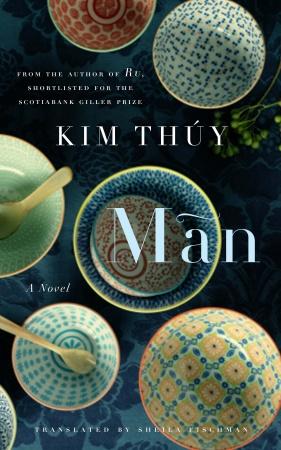
Mãn
by Kim Thúy, translated by Sheila Fischmann
Random House Canada, 2014 (originally published in French in 2013)
139 pages

Here's a thing I don't do often: read a book, and then immediately go out and find whatever I can by the same author and read that too. I did it in this case. And the strange thing is that - I liked Ru. I respected Ru. I didn't think I'd loved it. But perhaps, in some way that my own brain didn't quite clue in to, I did? It helped, too, that Mãn had just come out very recently, and working in a library, I had it to hand immediately.

It's a little hard to hang on to either of these books in specifics, in that they don't have much in the way of characters or plot. But they do have imagery and tone, and somehow Kim Thúy has managed to make those the driving force of Ru, and to a lesser extent Mãn. The latter does have more plot, and significantly more character. This may or may not be a good thing; I liked them both, and originally thought of Mãn as being the stronger, and underrated. But it's Ru that has stuck with me more clearly. Both explore the life of a woman who has come from Vietnam, as a refugee (in Ru) or after the war (in Mãn). The war plays a large role in both these novels, as does the experience of coming to a new country - in this case, Canada - and making a life here.

One of the meanings for the word "ru" is lullaby - Thúy explains this at the beginning of the book. In many ways, Ru struck me as a series of images that might bubble up before sleep. Ru and Mãn don't even really have chapters; they have paragraphs, or sections. Sometimes a section is a line or two long. Sometimes it's three, maybe five pages. I'm not sure there were any sections longer than that. Each is a painstakingly crafted image, memory, or moment, from a first person perspective. The narrator can be a bit dry, or maybe a better way to describe her is "reserved," but one gets the impression that she is always trying to be honest. Some of the sections are connected. Some of them are not, other than they have the same narrator.

Both start fairly slowly, especially because (to me at least) the format can come as a bit of a shock. Because neither book is structured as a typical novel, and without the usual components like a solid, chronological plot or dialogue or conventional characterization to hang on to, one can feel a bit adrift for the first little while. I worried about this, when I started Ru, because it's not a long book. I needn't have worried.

The books - most especially Ru, but Mãn as well, to a lesser extent - unfold like a series of beautiful blossoms, each page or section a memory, hanging off each other like a delicate string of pearls. If you hold them lightly, something wonderful happens. The reader does a lot of the work, filling in blanks. Nothing is explicit. But gradually a picture begins to develop - of Vietnam, of the life of a "displaced" person, of how a person can break apart and slowly be put back together, but never again without scars. Mãn, with its more explicit plot, does a lot more of the work for the reader. Which means that though I think it's stronger in some ways - it gives one more to sink one's teeth into - it also imposes itself on the reader, where Ru almost feels like it comes from within.

Neither one of these books will take you very long to read. And both are worth it. But if you're going to read just one, read Ru. Be prepared to open yourself to it, no matter how slow or odd it seems at first, as a reading experience; you will be rewarded.

Tuesday, October 13, 2015

Fangirl by Rainbow Rowell

I have this little thing, called a blog? And I used to write about books? And then one day I just stopped.

And then one day I just started again. So here we go. Bear with me, I'm incredibly rusty.

Fangirl
by Rainbow Rowell
St. Martin's Griffin, 2013
422 pages

Once upon a long time ago I read a book called Fangirl. It was one of the first books I read this year, in fact. And I loved it. The end.

No no, there's more - and I'm not going to do the book justice, of course, because I read it nearly a year ago, but here's the thing: I read this nearly a year ago, quite quickly, and I still think about it regularly and with a fair amount of clarity. The thing is, it's not just a nice book - and it is, a really nice book, where nice things happen and people are kind and awkward and lovely and maybe sometimes a bit mean but they aren't just awful for no reason. They all have reasons, and they are all sympathetic, even when they are not good reasons. There's no forced love triangle, there's no insta-love, there's no easy answers; there are just good people trying to work their way around being individuals and members of families and friends, which is not always easy and provides enough drama to make an engaging, charming, intelligent book.

More than just being a nice book, Rowell's writing makes the reading of it seem effortless. It's an easy read. It goes down smoothly. It's funny in the right parts, and tense in the right parts, and moving in the right parts. The pacing is absolutely dead on. I was worried that the excerpts from Cath's fanfic would stall things, or be uncomfortable to read (in the way that fiction-within-fiction can sometimes just be... weird) but those excerpts were delightful. I can see why people want to read more Simon Snow.

Me, I'll be reading more Rowell, regardless of whom she's writing about. Thoroughly enjoyed, highly recommended.

Saturday, January 24, 2015

three great graphic novels

Daisy Kutter 1: The Last Train
by Kazu Kibuishi
Bolt City Productions, 2012
153 pages

So, I hadn't realized this was re-released. I first started following Kazu Kibuishi online years ago, before Amulet was a thing, by reading his Copper comics. (I've got those in printed form too, now, so that will be reviewed here at some point.) But by the time I realized I was in love with his style and his sensibilities, his first graphic novel, Daisy Kutter, was no longer in print and unavailable anywhere. I was always sad about that because it looked fantastic.

Well, it is. One of my local comic stores supported Kibuishi's Kickstarter to reprint Daisy and I got their last signed copy, which you can imagine made me feel like queen for a day.

It's a steampunk western. Daisy is an ex-con who owns and runs a general store. It's pretty clear she's bored out of her skull by it, but it's a legit living. Her excitement comes from playing poker. So when she loses the store in a high-stakes poker match, she has no choice but to take up the winner's offer to give her the store back - if she participates in one last heist.

There are a few plot holes and the ending wraps up incredibly quickly, but this is the first in (I hope!) a series, and it was extremely enjoyable. Daisy's got depth, as does Tom McKay, the local sherrif who also happens to be Daisy's ex-partner in crime, and ex-partner, period. There are lots of questions to be answered, lots of fleshing out to happen with both characters. The world, while somewhat sketched-in for this first instalment, has a huge amount of promise. Very much looking forward to the next book.


Friends With Boys
by Faith Erin Hicks
First Second, 2012
220 pages

I find it hard to write about this one because all I want to say is LURRRRVE. This is a sweet, funny, quirky, sensitive, wonderfully-drawn coming-of-age graphic novel about a girl who is starting high school after being homeschooled her whole life. She has three older brothers whom she adores, and hasn't really ever felt the need for any friends outside of them. But they've all got their own lives and challenges at school, so she's kind of on her own. Lucky for her, she's not the only one in need of a friend.

What's nice about this is that it's not really deep or difficult, but it's still a portrait of a kid trying to find her place and fit in, while dealing with stuff - some mundane stuff, like dealing her mother's decision to leave the family or her first year at school, and some not at all mundane stuff, like the strange ghost who keeps following her around. Maggie's got challenges but she's competent, and her family (with the notable absence of her mother) is loving and supportive. This makes the book feel safe and a bit gentle, which is sometimes a nice thing in a coming-of-age book about outsiders.

This book is also really funny. The art supports the characters' development in the best way possible. Hicks can express a huge amount about a character just with facial expression and small gestures, and she uses that to full effect. It's an easy-to-follow style, too, meaning this is a great entree into the world of graphic novels. Excellent amounts of geek humour and an affirming message that being "weird" - however one defines it - is okay.


Ms. Marvel Vol. 1: No Normal
by G. Willow Wilson and Adrian Alphona
Marvel, 2014
120 pages

I'm not sure I really need to introduce this book. It's gotten a lot of attention because Ms. Marvel is Kamala, an American-born Muslim teenager of Pakistani decent, who in addition to having to deal with the sudden onset of superpowers and the appearance of a supervillain, has to deal with obnoxious, racist classmates, a fairly traditional family, a diet that forbids bacon, and a curfew. It could have smacked of diversity lip-service, but it was so well-written it didn't.

The book lives up to the hype. There are a lot of things to like here, from the fast-paced plot and the bright, stylized art, to the way it handles what shouldn't be a sensitive issue (Kamala's race and religion) but really is. But what I really appreciated was how realistic the whole thing feels from an emotional perspective, which is not something one can always say when reading superhero comics (or fantasy novels, for that matter.) While the title of the volume is "No Normal" what is refreshing is just how normal Kamala is, right down to the fights she has with her parents when she breaks curfew and is then punished for it. She's got superpowers and she handles their onset in a believable way. She's a teenager and she feels like a teenager.

Also, on a very frivolous note, I dare you to read this one and not fall a little in love with Boris.

Will definitely be following this series.

Saturday, January 10, 2015

Rose in a Storm by Jon Katz

8138952Rose in a Storm
by Jon Katz
Villard, 2010
240 pages

This was a fun and different quick read, good for a book club read over Christmas. It's a good winter read, too, for those of you who like reading "in season" - which is an interesting concept in itself. I generally prefer to read cold and snowy books in the winter; also I've noticed that in books set in the cold and snowy winter, the authors make the weather a big deal, not just background scenery.

For a book that wasn't terribly difficult to read it did get off to a slow start. I'd say it took me close to 50 pages to really get into it, but once I got rolling it went fast. Rose is a dog, specifically a working dog on a small farm, where she helps farmer Sam keep the animals in line and occasionally does other useful things as well. She is more of a partner than a pet, and Sam tends to see her as such; she is useful, not to be coddled. One winter, some time after Sam's wife Katie has died of an undisclosed illness (cancer, almost certainly) there is a tremendous, days-long, dangerous winter storm. It's up to Sam alone - and Rose - to keep the animals (sheep, dairy cows and some steers, chickens, a donkey) safe and alive through it as one disaster after another strikes.

The book switches easily and rapidly between perspectives - almost always Rose and sometimes Sam and occasionally a few other perspectives for a very short time. Katz knows dogs, and has done a lot of research and work in the area of dog psychology, and Rose's perspective is as close to what a dog's might be as Katz can possibly make it, while still making it readable. We still understand Rose, while recognizing that she's a different creature from a human, and has motivations and ideas and understandings about the way the world works that are different from what a human's might be. I'd say this was really successful, and while I've always quite liked dogs I came away with a lot more respect for them as separate creatures with agency and intelligence than I had before.

It's possible this was one of Katz's main aims in writing this book - and it occasionally reads like that, too.

One of the things that came home to me is just how dangerous a big winter storm can be, especially to farmers. I think it's easy to forget this, living in the middle of a city where your water pressure isn't dependent on the power being on, and your house is insulated (mostly), and the only creatures dependent on you to survive are in your immediate environs. The chances of a coyote getting in to eat your fish are small, and the most personal danger you're likely to see (except perhaps carbon monoxide poisoning) is having a heart attack from shoveling too much snow, and if you're hurt your neighbours are right next door. In short, it's easy to forget, being in a city, just how powerful and powerfully dangerous nature can be.

Even the problems I had with the ending didn't spoil the read for me. But the ending did unfortunately have some issues. Slight spoilers for the ending follow...


... ready?

This is the most blatant example of a deus ex machina I've seen in a novel in ages. I'm pretty sensitive to these, and I don't like them at all. If anything is swooping out of the snowy wild to save Rose and the farm it had better be set up well ahead of time. (Interestingly, my book club actually had significantly less trouble with this than I did: they thought the deus was clearly Katie, the deceased wife. I can see where they're coming from but I didn't see it clearly enough ahead of time to make it better, and I'm still skeptical.)

The other thing is that I don't think a rescue was necessary; I did think Katz had built up to an unsustainable level of tension and conflict, and I think if he'd dialed things back a bit before the climax he wouldn't have needed a deus ex machina, explained by Katie or otherwise, to wrap things up. He could have dialed things back without losing the forward momentum or the dramatic tension, too; things were plenty dramatic as it was. And then he wouldn't have needed something out-of-the-ordinary to rescue his happy ending.

... /end spoilers

Overall, aside from the ending, this is an entertaining and interesting book, something outside the ordinary. Recommended to animal lovers for sure, and people who like snowy rural stories. It's an easy read and a worthwhile one. I'll definitely be reading more of Katz, though I think I may stick to his nonfiction.

Saturday, November 22, 2014

The Briefcase by Hiromi Kawakami

The Briefcase
by Hiromi Kawakami (translated from Japanese by Allison Powell)
Counterpoint, 2012 (originally published in 2001)
176 pages

"But of course, if I really paid attention, there were plenty of other living things surrounding me in the city as well. It was never just the two of us, Sensei and me. Even when we were at the bar, I tended to only take notice of Sensei. But Satoru was always there, along with the usual crowd of familiar faces. And I never really acknowledged that any of them were alive in any way. I never gave any thought to the fact that they were leading the same kind of complicated life as I was."

I've wanted to read this book for years, but I didn't realize it was actually released on this side of the pond with a different title and I've been spending a lot of time waiting for the book Strange Weather in Tokyo by Hiromi Kawakami to make it over here. Turns out it's been released for a couple of years in North America as The Briefcase. Either title is apt. Glad I finally found it.

Of course, as is always the case with books that one waits ages for, I'm not sure this one quite lived up to the hype in my head. I think part of that was the translation, which didn't seem quite as... lyrical as I'd hoped and expected, but a little more workmanlike. Which is fine, and may reflect the style of the original writing, but wasn't exactly what I was hoping for when someone compared this to one of my all-time favourite books, The Housekeeper and the Professor by Yoko Ogawa - the only things in common I see between the two is that they are by contemporary female Japanese authors, and feature a female first person narrator.

The Briefcase is, however, as advertised by its UK title, strange, and once I was rolling with it there was a lot to like about it. Tsukiko, our narrator, is a Japanese salarywoman - we never hear exactly what it is that she does - she is single, she is idiosyncratic, she is emotionally detached, and she knows it. She struggles to connect and yet she's not really all that interested in connecting. She drifts around but she's not really interested in putting down roots. She's inexperienced, emotionally and in most other ways, but she's not really interested in getting experience, other than because she thinks she probably should.

It is also a love story; Tsukiko meets the man she thinks of as Sensei, a retired high school teacher, at the local bar, where she often spends her evenings. It might complicate things that he used to be her high school teacher, but they are both well beyond those days (Tsukiko is in her late thirties, Sensei in his seventies), and didn't much like each other back then if they thought about each other at all. It is Tsukiko who finally breaches the gap between them, who declares herself, much to her own chagrin and even surprise. They are both terribly awkward and somewhat wounded, though Sensei doesn't appear to let either of those things bother him at all.

If anything, this is a study of loneliness and quiet, and the difficulty of connecting with others in the world. It's not depressing, is the interesting thing, or sad. It is melancholy and contemplative, but it's also a little bit funny at points, and it celebrates certain aspects of life - food, mostly, and the brief, transitive connections we do manage to make. Tsukiko is frustrating as a narrator, but she's frustrating in a believable way, and she's interesting, despite the fact that she herself would certainly deny that characterization. The reader hopes for the best for her, even as we realize that she's probably going to sabotage herself. It might not be serious sabotage; but it will be a sort of sabotage that always leads her back to her dreary, lonely status quo. There is something strangely poignant in that.

In the end, I don't quite know whether to recommend this or not. It has stuck with me, since I finished reading it months ago (took notes! hooray!) and I found it a relatively quick read. There's not much plot (always okay by me) and the character development is... elliptical, might be the best word, though Tsukiko's character is strong and unique. The language is workmanlike. But it's unusual, and a little haunting, and probably worth a read if you're interested in contemporary Japanese fiction.

Tuesday, November 4, 2014

All Men Are Liars by Alberto Manguel

All Men Are Liars
by Alberto Manguel
Riverhead Books, 2012 (originally published in Spanish in 2008)
224 pages

Well, it's been months since I finished this book. Luckily I took good notes.

Originally published in Spanish, this is a novel in five distinct parts. An investigative journalist, Teradillos, is trying to get to the bottom of the story of a famous literary figure by the name of Alejandro Bevilacqua, an ex-pat Argentine who died under mysterious circumstances in Madrid. The first person interviewed is Alberto Manguel himself (in case anyone is curious, Bevilacqua is indeed a fictional character). Manguel tries to distance himself from Bevilacqua, whose body was found under Manguel's balcony when Manguel was out of the country, but is not very successful at it. The second part is told from the perspective of Bevilacqua's lover, the third from a character Bevilacqua spent time in an Argentine prison with, the fourth from another person in Bevilacqua's past, and the fifth and shortest from Teradillos himself.

Hmm. My notes begin: "I am too stupid for this book" which is an interesting statement. Let's dissect it a bit.

This is indeed literary fiction, and I don't read a lot of that. What's more, it's interesting and ambitious literary fiction that winds, maze-like, around itself. It doesn't take itself too seriously but it is serious. I haven't read widely enough to be able to follow all the perambulations and permutations, and I'm only just familiar enough with Latin American history to understand a little of what is happening. This is a novel about Argentina under a dictator, a novel about disappearances and corruption, exiles and torturers - even at a remove, being set as it is in Spain and France thirty years on from the events so central to the tale. What's more, it's about the ordinary faces each of these things have, about the banal people behind the atrocities, about the banal people who get caught up in them. And how those ordinary, seemingly boring people, can be fascinating in and of themselves.

It's also about how we tell stories about ourselves and others, and sometimes we know that we're crafting fictions and sometimes we're blissfully unaware of it, but we are nothing but our stories either way. It helps our case if we are in control of our own stories - the author and wordsmith in the third section, the man who was a prisoner with Bevilacqua, presents the most coherent and convincing tale of all of them, and yet because of the structure of the novel we're aware that it is just a story, even as we fully believe it.

In short, I'm not sure I am in fact too stupid for this book. I think I did pretty well with it, for all my inferiority complex about reading literary fiction. And I enjoyed it, too. Something I did do, though, was spoiled it a bit for myself, which was objectively stupid - don't read ahead in this book if you can help it. And even if you can't. Part of the enjoyment of it is letting it unfold slowly, letting the mystery slowly solve itself. I learned a fact too early by seeing something quite a bit further along in the story than I was myself, and I think I would have enjoyed it much more if I'd let it unfurl in the way Manguel meant for it to unfurl.

My notes on the first two sections are incredibly detailed, and then I read the third and got totally swept up in it such that I didn't bother taking notes, but it's the section I remember most vividly. 'Apologia,' the first, is told from Manguel's own "perspective" and while we learn the basic details of Bevilacqua's life through him, we also gain an incredible amount of insight into the character Manguel has created of himself - that he is a little self-indulgent, a little delusional, not entirely in touch with his own feelings. He repeats multiple times that he was not fond of Bevilacqua, that Bevilacqua foisted himself on Manguel as an unwanted guest; but one suspects Manguel was more fond of Bevilacqua than lets on even to himself.

The second section, 'Much Ado About Nothing,' is an about face. Manguel is a liar and a sad sack, full of himself and totally useless, generally. Andrea, the narrator of this section, is at least as delusional as Manguel, and less self-aware; she's a narcissist. Everything that matters, matters on her terms. She was Bevilacqua's lover, but it's clear to the reader that she was in love with her own idea of the man, not the man himself. The Bevilacqua she discusses is a very different one from the man Manguel tells us about - the two are almost irreconcilable, but because of Andrea's inability to countenance that anything beyond her own version of events and people might have merit, we give more credence to Manguel's version despite the fact that Andrea was objectively closer to Bevilacqua.

There's more to say about Andrea, but I can't without major spoilers. Suffice to say that even though she's not a terribly subtle character, there are some subtle ways in which Manguel (the author) reveals her to us. This story, though technically about Bevilacqua, tells us more about the people around him than about he himself.

The third section, as I say, is the most self-aware and the best-written, and the quality of the writing leads us to believe it almost unconditionally even though we know these are personal accounts by people with vested interests. We remain objectively aware that we are reading a story, one person's version of events, but we cannot help but lend this particular person weight because of the way he tells his story. There's quite a lot to be said for this.

The fourth section was where things fell down for me a bit, told as it was from beyond the grave. It explained a lot of things that were left as mysteries in the first three sections, and while it was... fine? I would have been okay if those things were left unexplained, or ... explained in a more subtle way, like the rest of the story had been up to this point. This section felt kind of heavy-handed, unlike the earlier portions. It was well-done for what it was, but I wasn't sure it fit.

The fifth section, Teradillos' own, was a satisfying, solid ending, but there's not too much else to say about it beyond that.

Do I recommend this book? I certainly read it quickly and I enjoyed it. What's more, I think I have enjoyed thinking about it even more than reading it. I don't think it's absolutely brilliant but it was engaging and thought-provoking, and it's hard to ask too much more from a book. For fans of historical fiction, Latin American fiction, and literary fiction especially, but even if you're none of the above, this is an easy read to help you stretch out of your comfort zones.

Saturday, July 26, 2014

The Storied Life of A.J. Fikry by Gabrielle Zevin

The Storied Life of A.J. Fikry
by Gabrielle Zevin
Viking Canada, 2014
258 pages

This is a book best read by people who love words and stories. It's not a heavy story (surprising, given some of the subject matter) but it's heavy on the literary references and book world in-jokes. This is an easy, fast read, gently funny and somewhat predictable, which makes it a very comfortable summer read, even for someone like me, who generally doesn't read a lot of contemporary fiction because I like to keep reality out of my reading space.

A.J. Fikry is the owner of Island Books, a small literary bookstore on Alice Island. It's a quiet place in the winter, and a very busy place with tourists - the summer people - in the few sunny months. Things are not going the way A.J. planned; his wife, and business partner, was killed in an accident, and business is slowing, and A.J. is not the sort of person who can attract business the way his vibrant, socially adept wife could. But things are about to change for A.J. and his small circle of friends and acquaintances, with the introduction of a small, abandoned girl into his bookstore and his life.

I think if anything I'd maybe describe this story as a bit of a love letter to short stories, a mild statement on the value of sharing books, and a bit of a fairytale. It struck me that it managed to be neither maudlin nor manipulative, both very easy traps to slide into with a book like this, which I appreciate hugely. It wasn't terribly deeply examined either, so while some very difficult things happen to some of the characters, I'm not sure how much staying power this book has with me in the grand scheme of things. Weeks after I've actually finished reading the thing, I'm still enjoying the afterglow but maybe not as loudly enthusiastic as I was.

One thing that did strike me as I was reading was the way Zevin used multiple narrators. I am not usually a fan of this technique in the way Zevin was using it. Many times certain narrators have very important bits of information that other narrators don't, and because we care about what happens to these people and the relationships they have with each other, it becomes very tense, wondering who will find out what when and exactly what the fallout will be, and suspecting it will be very unpleasant for everyone involved. However, I think because of the way Zevin handles her characters, which is gently, I trusted her. The tension was there, but not overwhelming, and left space for enjoying the other aspects the story. Namely the literary references and the book world in-jokes.

Also, her foreshadowing is pretty clear. The ending, though not its specifics, is telegraphed, and I saw it coming. I was supposed to. I appreciated this as it meant nothing was a huge surprise (or not much) and it occurs to me that I'm not wild about being surprised in books, at least not about some things. At least not in the usual course of things.

It's not a remarkable book, but it's lovely and charming and - I've used this word already a couple times, but it fits - gentle. It's funny and if it treads lightly, that's okay by me. A recommended speedy, very readable summer book. Book clubs will likely get some mileage out of it, though hard to know how much. It might be fun to pair a couple of the short stories that form the backbone with the book; the Flannery O'Connor alone packs a more visceral punch than the whole book, if you like that sort of thing.

Thursday, July 3, 2014

Apologize, Apologize! by Elizabeth Kelly

Apologize, Apologize!
by Elizabeth Kelly
Knopf Canada, 2009
320 pages

This is a book that, like the family it chronicles, is a little dysfunctional. It has a severely split personality and I felt quite strongly that it got away from the author around the 3/4 mark, but she did bring it back, in the end. It's possible I was so thrown by those sections because this is not a usual kind of read for me, but despite the fact that I was a little blindsided it felt a little formulaic, too, which is a very odd juxtaposition. I saw it coming but couldn't quite believe it when it happened.

See, the thing is, a book tends to have a certain tone. And as much as explicit foreshadowing can, the tone can set the stage for what comes; the reader knows that there will be something of a certain magnitude and a certain temperament down the road. Part of an author's job is managing these expectations, I think. What happened to me as I was reading this book was that I did hit the crisis of a certain magnitude, as I expected - it was heavily (but not heavy-handedly) foreshadowed, the tone and early plot very nearly demanded it - but then rather than maintaining the level, several other events of enormous magnitude and very different temperament happened, and they felt out of place, though I understood where Kelly was trying to go with them. We veer crazily from madcap family tragicomedy to a war zone to medical malpractice before we finally come back to our senses, rather than unfolding in a way that feels both logical and emotionally true. I ended up with whiplash.

Which is not to say that this book doesn't have it's excellent moments, and I read it very quickly, almost compulsively, and I liked it, in the end.

So, the summary: Collie (yes, named after the dog) is a first-person narrator, detachedly telling us about his early life and his loudly dysfunctional, incredibly wealthy, strangely endearing (most of them) family. He sees himself as the sane one, the normal one, but he loves all of them, even his emotionally and sometimes physically abusive mother (I didn't see anything likeable about her at all; she had no redeeming qualities whatsoever, which makes her the odd one out in the book) and he spends a lot of his time wanting to crawl into a hole to die of embarrassment, attempting to contain the damage, or trying to coax some sort of order out of the chaos. He's a very sympathetic narrator, and he doesn't spare himself. Dysfunction has made him who he is and he's benefited hugely from the wealth and profile of his family, but he's also very aware (and the reader more so) of just how destructive the dysfunction he grows up around is to everyone touched by it. It's not harmless, even if it is really funny a lot of the time.

One of the blurbs compares this to a Wes Anderson film, and while I try to take those with a grain of salt, I think that one is quite apt. The madcap antics of the eccentric characters that appear harmless on the surface, the underlying melancholy, the peaceful moments, the black humour, the slow unfolding of a tragedy that seems inevitable. That's the first part of the book and it holds up as a comparison. The rest of it not so much.

Collie is the most relatable character in the book, perhaps excluding the verbose, blustering but quietly tender Uncle Tom (acting as the family's live-in maid and servant, pigeon racer, alcoholic.) But getting back to my point that the dysfuction, while amusing, is not harmless: Collie is also incredibly dysfunctional in his own way. Because of the way he has grown up and the personality he has, he is a person whom things happen to; he is at the mercy of everyone around him. He is not forceful - almost religiously not forceful - and he doesn't hold convictions, and he doesn't have any follow-through either. He's a limp fish and while he doesn't ever ask for exoneration, it is not hard to imagine him saying "really, it all had to turn out like this."  And yet somehow I still liked him.

Tonally the book is uneven, but I did enjoy it for what it was, and I'm glad I read it. Mildly recommended to fans of contemporary dysfunctional family narratives (it's a whole genre!); you won't find it a difficult read, and it's got some lovely moments.

Tuesday, December 31, 2013

The Higher Power of Lucky by Susan Patron

The Higher Power of Lucky (The Hard Pan Trilogy 1)
by Susan Patron
Atheneum Books for Young Readers, 2006
134 pages

I am turning over a new leaf a couple of weeks early, and never again assigning books for my parent-child book clubs that I have not yet read myself. I have good reasons for this. I had never read this book, but I've wanted to for years, and aside from the fact that it won the Newbery and I was pretty sure it would be fantastic, and that Darla recommends it, I knew very little about it.

Loved this book. Let's get that out of the way first.

Am not sure the kids in the group will love this book, but I think the parents will enjoy it, and I certainly hope they won't throw a fit over the word "scrotum" appearing. We shall see. It's a quieter story than the kids in this particular group tend to like, but it's also very short, so I think there is potential here. Also, it's hard not to love Lucky.

Lucky lives in the tiny town of Hard Pan in California, a little place in the middle of the desert that used to be a mining town but has dwindled down to a population of 43. Two of those people are Lucky and her guardian, Brigitte, a beautiful woman from France who has come to take care of Lucky at the behest of her entirely absent father, since Lucky's mother died two years before. And Lucky is certain that Brigitte is planning to head back to France any time now, leaving her entirely orphaned, so she will have to leave Hard Pan, and her friends Lincoln and Miles, her dog HMS Beagle, and everything she knows. So now Lucky really needs to find her Higher Power, like the people at the twelve step meetings she keeps eavesdropping on, because Lucky is planning to run away.

She is such a prickly child, Lucky. And she's an odd duck, there's no question. She has a very particular way of looking at the world, and it's highly amusing to an outsider, but to her it's a very serious way. She is working her way as logically as she can through some very difficult things - her mother's death is raw, and her fear of being abandoned is constant - and while an adult reader can look at Lucky and wonder exactly how she comes to the conclusions she does, they make perfect sense to the child Lucky is. She is also good-hearted, curious, and passionate. Her greatest hero is Charles Darwin. She likes snakes. How could I not love this kid?

Also, she is the kind of kid who describes things like this:

Lucky had the same jolting feeling as when you're in a big hurry to pee and you pull down your pants fast and back up to the toilet without looking - but some man or boy before you has forgotten to put the seat down. So your bottom, which is expecting the usual nicely shaped plastic toilet seat, instead lands shocked on the thin rim of the toilet bowl, which is quite a lot colder and lower. Your bottom gets a panic of bad surprise.

"A panic of bad surprise." Isn't that great?

The other characters, particularly Brigitte, Lincoln, Miles, and Short Sammy, are seen through the very close lens of Lucky's perception, though the book is told in third-person. They are therefore somewhat limited in their characterization, but Patron does a good job of fleshing them out as well as she can for us. We see through Lucky's eyes, but we notice things that she does not, in her descriptions of events and reports of conversations. And Lucky is a pretty observant kid, about many things.

It would be remiss of me to forget to mention the charming illustrations by Matt Phelan sprinkled throughout the tale. They're pencil, black and white, and they perfectly suit the mood and tale, and bring Lucky and Hard Pan to life in a slightly whimsical way.

So, yes. This book: recommended. It's maybe not a must-read for an adult, but I don't think you would go wrong by reading it, and the story and characters have stuck with me well after the book was gone. I'm looking forward to seeing how the kids react to it. Kids who are looking for contemporary stories will eat this up. It's amusing, silly, serious, charming, and just the right length.

Tuesday, November 26, 2013

Because of Winn-Dixie by Kate DiCamillo

Because of Winn-Dixie
by Kate DiCamillo, read by Cherry Jones
Random House Audio, 2001 (text published in 2000)
2 discs, unabridged

This is not my first time around for this book, and I'm very happy to report that I'm sure it won't be my last, either. It improves on re-reading. Of all of the books I have read with my parent-child book club over the last three years, this has remained a steady favourite. I can think of only one or two other books that my veteran members mention as much, with as much fondness, as they mention Winn-Dixie. So when we started a second parent-child book club, this was a no-brainer choice. And when my first book club participants have all grown out of it and I'm on to a new crop of families, I'll read it with that group again.

I often don't re-read the books that I've already read for book club again, but I loved this when I read it the first time. The audiobook seemed like a good choice, and it had been a couple of years; a refresher was in order.

I'll refer you to my original entry on this book for the summary. Instead, here I'll talk a bit about the audiobook, and some of the things that occurred to me this go-round.

The audio is well done. Cherry Jones does a solid narration job, and brings India Opal Buloni and Naomi, Florida, to life. Her accent is broadly Southern and puts this Canadian more in mind of Georgia than Florida, which might have surprised me more if one of the parents in the group hadn't mentioned it to me before I got my hands on a copy. But it fits, and the cadence of Opal's voice as written really comes to life when read. It adds an extra flavour to the text, which is already rich with the feel of a small town in Florida in summer. And on audio this book is a breeze, at under two hours. It goes by almost too quickly.

I really noticed two things this time through, and they're completely unconnected. Mechanics first: this story is spare. The fact that I recognized it this time might have been exactly because the audiobook feels so short. Kate diCamillo is an expert at understatement, and there is not a single detail in this book that does not need to be there. She knows where to focus her (and therefore our) attention, and how to make time pass without narrating its passing. And she is concise. Opal and the preacher (her father) have a deeply loving relationship, and a complex one, and it is drawn in its complexity and depth with a few spare strokes. Characters, too, are drawn so carefully yet so naturally that one knows them within a few lines and yet they're not one-dimensional, unless Opal sees them as one-dimensional. And when she grows out of that view, it doesn't take more than a few words for the reader to grow their understanding of the character as well. She's a master of concision and it is a beautiful thing to read (or hear.)

The other is that though Winn-Dixie the dog may be a catalyst, he's not the star of the story as much as Opal thinks he is. She doesn't recognize it herself, but it's her integrity, bravery, and kindness that lead to the changes that happen to her over the summer. She may be braver because Winn-Dixie is beside her, but the decisions she makes are her own, and her choices to seek friendship where others might not, and to foster ties where others might not, to open lines of communications that have been silent previously, are the choices that make the difference, not Winn-Dixie's sunny, intelligent, gentle personality. And not that kids' stories have to have "good messages," but this one, in addition to being a lovely, entertaining, funny, sweetly melancholy story, does. It's a message about being kind and looking beyond the surface. That's not a bad thing to take away from a book, for a child or an adult. It's nice that one doesn't feel Messaged At to get to that point, too.

It's hard for me to say whether or not, if you are only going to do one or the other, you should read this or listen to the audiobook. Either is a good choice. But definitely do one or the other. Don't pass this book by.

Wednesday, October 2, 2013

Days of Sand by Hélène Dorion

Days of Sand
by Hélène Dorion (trans. Jonathan Kaplansky)
Cormorant Books, 2007 (original French published in 2002)
111 pages

This is a book I've been holding on to for a long time. I've wanted to read Days of Sand since I read a review when the English translation was first published. Some years later I received it as a Christmas gift, since it didn't seem to exist in any of the many libraries I have access to; it was apparently a difficult book to find. Some time after I started trying to read it. Now, years later, I have finally finished it.

I don't remember exactly what it was about the review that triggered my interest, but it seemed like the perfect sort of read for me right now, where books with a strong narrative or long chapters or a page count over about 150 seem to be eluding my grasp. I love books where the focus is on language, where it is the intrinsic beauty or the rhythm or the feel of the words themselves that hold the reader, not necessarily the plot or the characters (see my longtime adoration of Michael Ondaatje's work, for example, though I'd not say he can't do plot or characters; he just doesn't have to, in my opinion.)

On the surface, Days of Sand is exactly the sort of thing I like. Very short sections, three pages at the most, each focusing a lens on a single idea or memory. Very little narrative, though the cover says it's a novel. In fact, I'd say it's largely prose-poetry, each piece a contained bit of carefully put-together language, designed to evoke some reaction in the reader -- recognition, sympathy, understanding, alienation, memory. But also very much to my taste, the emotion evoked is not manipulated out of the reader. The text trusts the reader to make a connection; it doesn't force it.

And I hate that this book wasn't quite right for me after all. I desperately wanted to like it, and I really did try. It's Canadian, it won the Prix Anne-Hébert in 2004 (clearly someone liked it, or several someones) and I remember the review being full of praise. It feels deeply personal, though it is a work of fiction. It's from a tiny Canadian publisher. It's an odd little book that I expect deserves a wider audience. Except... except.

I don't know if it's the translation, or that the rhythm of the author's original prose works better in French (I suspect both) or if it's just that Dorion's writing just really didn't work for me. I felt I was working against the prose in many places, fighting with it to wring out meaning and connection. I got there at some points. At other points I was just bored by what felt clumsy, pedestrian repetition without any point, and -- get this, coming from me -- an overabundance of commas where other forms of punctuation or none at all would have better served the text.

It wasn't all disappointing. There were moments of brilliance. There is an entire section where the narrator talks about being at the beach as a child -- the section that the title comes from, verbatim, though it has significance throughout the book -- that absolutely shines. There are other delightful little moments, beautiful bits of writing that felt like truth and also like art. The meditations on memory and words and existence are incisive, if not always original, and I think I can safely say that the moments where I did connect to the text were worth the many moments where I did not.

It is possible, too, that I should have read this differently. I maybe should have read it all in one go, or as much as possible, rather than a section here and there, sometimes with days in between. It might be that I need time and exposure to get the feel of the text, and that by reading it in small pieces I never really got to experience the full effect. I do suspect there is something in this, as the few times where I read more than two or three sections at once, I felt much more positive about the whole experience.

I am glad I own this book, because I think perhaps it deserves a second chance at some point down the line. But it is hard to say if I would recommend it, or who I would recommend it to. I'd love to read it in its original French and compare the experience; I'll get back to you on that once I've learned enough French. Until then, I'm saddened that I didn't like this better than I did.

Tuesday, August 13, 2013

The Penderwicks by Jeanne Birdsall

The Penderwicks: A Summer Tale of Four Sisters, Two Rabbits, and a Very Interesting Boy
by Jeanne Birdsall
Oakhill Audiobooks, 2008 (originally published in 2005)
6 discs, unabridged

This book feels like an older children's classic -- along the lines of The Railway Children, say -- and yet is relatively recent. It felt like I was listening to a story from my childhood again; only this was brand new, with new characters and new adventures. And I'd say Jeanne Birdsall has taken pains to make sure this book will remain as timeless as possible; there are telephones and cars, but no mention of what sorts of telephones and cars. Technology doesn't really make an appearance, aside from a mention of a computer that one of the girls uses once, and though that itself could make the book feel dated, it doesn't. This is a summer tale, an outdoor tale, a tale of four girls and a cottage and a lovely extended vacation. With, as the book's subtitle mentions, two rabbits and a very interesting boy. And a dog. And another very interesting boy.

Maybe I am just a sucker for this sort of thing, but if that's so, I'm in good company: The Penderwicks won a National Book Award the year it was released. It has played very well with the adults who give out awards and starred reviews. It first came to my attention through the discerning Aarti. I am curious to know if it will play as well with kids. My child-parent book club is going to be reading it next spring, to get them set for summer, and I'm very curious to know if they will enjoy it as much as I have.

The Penderwicks, four girls, their loving but somewhat distracted father, and their dog Hound, are on summer vacation. Seeking a last minute cottage rental, they've chanced upon a place called Arundel -- a grand estate in the mountains, a mansion with beautifully manicured gardens. Their cottage is a humble, but lovely, little place behind the mansion, hidden from the main grounds by a tall hedge. And while that would be fun enough for four girls with big imaginations and lively curiosity, there happens to be a handsome young gardener (handsome enough and young enough to turn eldest Penderwick Rosalind's 12-year-old head for a first crush), a friendly and comforting housekeeper, a nasty, shrill, very rich lady who owns the place, her sneering suitor, and her mysterious son, who happens to be just the right age to make an ideal playmate for the girls.

And the girls play. They get into all sorts of scrapes and wild adventures over their three week vacation, some of them inadvertent and some of them deliberate, some of them dangerous and some of them harmless. They are good-hearted, imperfect, and impulsive, which makes for excellent stories. You're always rooting for whichever Penderwick is featured, even when you know she's squarely responsible for her own tricky situation. What makes this book are the characters, not necessarily the storylines; and not necessarily the secondary characters, either. Mr. Penderwick is charming, but hardly there (not in a bad way, mind you, and when he needs to be he is there) and Churchie the housekeeper, Harry the Tomato Man, and even Cagney the gardener are all pretty one-note, though very alive and each quite likable. Mrs. Tifton and her suitor are pretty much caricatures and extremely dislikable. It's the four girls -- motherly, responsible Rosalind, difficult and brilliant Skye, dreamy Jane, and shy little Batty -- and Jeffrey Tifton who make the story worth reading. They are gently handled by Birdsall, even Skye, who I'll admit was a challenging character for me at first though she did grow on me. Their dreams and fears and feelings are all considered fairly and without judgement, and they felt like very, very authentic people. I'm not so far away from Jane or Rosalind (though Skye is pretty foreign to me) that I don't remember what that was like. Birdsall has it pretty much dead on.

Which lead to a couple of very uncomfortably squirmy moments for me, listening in the car. At one point I actually stopped the audiobook cold without even realizing I'd planned to do it, just before Skye did something she should not have done, but that I couldn't blame her for, that I kind of wanted her to do, but that I was painfully aware was going to be mortifying for her and therefore by extension for me. Except when I realized what I'd done and turned the audio back on, it wasn't as bad as I'd feared. Birdsall once again treated Skye with dignity and didn't play up the full mortifying horror of the situation for amusement or tension as a different author might have done.

The reader of the audiobook, Laurence Bouvard, is a voice actor and veteran audiobook reader, and that comes through. Overall the narration was good. I occasionally had some trouble -- Jeffrey and Cagney sounded pretty much the same to me, and Mr. Penderwick just sounded silly and dopier than I think he was, text-wise. However, her voices for the four girls were brilliant and I never had any trouble telling any of them apart. I do find children's audiobooks can be really hit or miss for me; I don't like being talked down to and can't stand it for an entire story. I wouldn't say this was an entire hit, as it occasionally skirted that very subjective line, but it certainly wasn't a miss.

A warm, engaging, fun, gently-told story that appeals to me for any number of reasons. I think this would be a perfect family read-aloud, especially for the summer... or maybe for the cold spring, when summer seems too far away and a little warmth is needed.

Tuesday, July 16, 2013

The Secret Life of Prince Charming by Deb Caletti

The Secret Life of Prince Charming
by Deb Caletti
Simon Pulse, 2009
336 pages

Having been working on this book for ages (it was my "at work book" -- read during fifteen minute breaks, mostly, with the occasional half-hour lunch thrown in), once I finally finished it I put down in writing that I'd like to read pretty much everything else Deb Caletti has written. This is not my usual response to YA books, which generally get me all excited to read them and then end up disappointing me something fierce. It is even less my usual response to contemporary lit, and even less my usual response to reading a book targeted so squarely at females only (my fondness for romance novels notwithstanding). I mention that this was my at-work-book only because those books have to hit a particular, rather challenging niche: they have to be light enough that reading them in fifteen minute chunks is not a detriment to understanding the story and getting things out of the book, but engaging enough that I a) remember what happened last time, and b) want to use my precious break time to read it.

Quinn Hunt's parents are divorced, and she and her little sister Scout live with their mother, their mother's sister, and their mother's mother. After a significant period of time not seeing him at all, Quinn pushed her mother to allow her to reconnect with her father, a performer/manager/owner of a Vaudevillian stage act. The divorce was messy and the relationship between their parents continues to be acrimonious, but Quinn is desperate for a relationship with him, wants to know him and be known to him, so her mother allows it. Five years later, seventeen-year-old Quinn is generally happy with the way things are going -- she thinks. But then, during one visit, something happens. Something that changes everything, even though she desperately wants to ignore it. And suddenly Quinn finds herself on a mission with Scout and her estranged half-sister Frances Lee to meet the women of her father's past, and hopefully discover the truth of who her father is.

So we have here a tale generally about love and integrity. I've seen some people around the webs complain that it's "anti-male" and a bit heavy-handedly negative, and I find I can't quite agree. It's not even that obviously didactic in most places -- though it is didactic, and occasionally does slip a bit into blunt-force. But overall the story is so well done, and the characters so vivid, that the message(s) that Caletti wishes to convey are pretty well incorporated. That is, this is an Issues book that doesn't feel so much like an Issues book that I couldn't read it for the story and the characters. It's also the sort of Issues book I'd like every young woman in my life to read.

The topic of "love" doesn't just extend here to romantic love, though that is something of a focus, particularly of the didactic bits. But it's also a lot about familial love -- love between sisters, between parent and child, between absent parent and child. It has a lot to say about what constitutes a family. It has a fair bit to say about divorce (neither pro- nor con-, though it's clear that Caletti would like to encourage young women to avoid divorce by the dint of not letting a relationship that isn't working or isn't healthy get so far as marriage in the first place). As someone who has been extremely fortunate to grow up with an intact, generally very functional nuclear family, I learned -- grew to understand -- a lot about the challenges of kids of divorced parents. Granted, in this case, one of the parents is a tremendous asshole, and that's not always the case, but there are things I think must be common to kids who have two parents who split amicably, too. In particular the way Quinn describes the way children of divorce are expected to cope with their parents' new relationships and all that comes with them really struck me.

As to "anti-male," it's not terribly. There are a couple of examples of good, healthy, lovely relationships in the book, too -- each different from the other, but present. But anti-asshole this book definitely is. It's also very clear that while some guys are assholes, women need to take responsibility for their relationships, too. Not in a shaming sort of way, but in a way that recognizes that everyone makes mistakes -- it's about correcting that mistake, and not letting it define you or ruin your life out of some misplaced sense of obligation, fear, or shame. The book is pretty clear on the kind of damage a bad relationship can do, the consequences it can have, even when it's not technically "abusive" in the obvious meaning of the word. I wondered, as I read, where the line between just being a bad father or husband and being emotionally or psychologically abusive is. There is no answer to this in this book, but the damage done is clear and present.

Quinn is a great character; a bit of an every-girl, with a professed love of math (not explored nearly enough for my taste, barely makes a dent in the book proper) and a deep desire to do things right. She's also one of those people (I know this, because I am one) who desperately needs approval, even when its source isn't necessarily the right one. She wants people to like her, she wants to be a good daughter, she is absolutely a good sister. But she's also brave, in an accidental kind of way, and I like that it is accidental, and then she just goes along not necessarily for bravery's sake but because she's committed and doesn't want to back down. She is relatable, but not completely without her own personality; she has a strong voice, at times humourous, at times raw, always easy to read.

Not a perfect book, and not for everyone, but highly enjoyable if you enjoy contemporary women's fiction and don't mind a young adult narrator. Low-key romance, and occasionally a bit didactic, but never dull. Often funny, often touching, often thought-provoking. And both heavier, and lighter, than I've made it seem here. Looking forward to more Caletti in the future.

Thursday, January 24, 2013

Mockingbird by Kathryn Erskine

Mockingbird
by Kathryn Erskine
Philomel Books, 2010
256 pages

I was expecting a somewhat intense read from this one, a bit of a heart-wrencher, even. I wasn't quite expecting the punch in the gut I got when I realized what had happened to Caitlin's brother. And then I read the Author's Note (quite appropriately, thankfully, placed at the end of the book) and realized that what I hadn't expected was in fact central to the conceptualization of the novel; not an aside, as I had thought prior to reading the book, but the reason Erskine wrote Mockingbird in the first place. Makes me realize that my After School Club and I are going to have a hell of a discussion when they're done reading this one. I'm really curious to see what they thought. Consensus from the few who have finished it is LOVE. That includes one of the parents, who said she bawled through her breaks at work because she couldn't put it down once she'd picked it up out of curiosity.

Hard to talk about this without spoilers, and I'm glad it wasn't spoiled for me, so I'll try not to spoil it for you.

However, those of you who have read this and want to discuss, I declare comments a spoiler zone. Be warned. (Also, be warned that the Wikipedia page for the book is a veritable minefield.)

Instead, I can talk about what everyone knows from the summary of the novel: Caitlin is a ten-year-old girl with Asperger's syndrome. She's bright, loves to read, and is an amazing artist, but she's socially inept. She can't figure out people, and she's not sure she wants to bother. Especially now that Devon, her older brother who always explained things to her, like why she can't do certain things and why she has to do others, is dead. Devon's gone and Caitlin's father is sad, and Caitlin is adrift in a world that doesn't make sense to her without anyone to help her navigate it; all she has is her trusty Dictionary, a list of things she's really good at, a school counsellor, and Devon's memory to help her along.

Mockingbird is told from a perspective that feels at times pretty alien, but Erskine does an excellent job of making Caitlin relatable. I'll be curious to see what the kids think about the perspective, and how they feel about the idea of a writer trying to put herself in the shoes of someone with such a different way of seeing the world; it's a question I always struggle with, myself. Caitlin's voice does feel real, and the portrayal of her mental processes is nuanced and careful without feeling over-cautious. But... is it... authentic? Is that really the way people with Asperger's view the world? And if it's not... where does that leave us? Does it matter? I struggle with this. I would struggle with this further here, but the fact that I've written the next two paragraphs of this review four times and never once been articulate myself well enough to publish it suggests perhaps this isn't the time.

Suffice to say, I am curious about the perspective, and I am cautious for a whole multitude of reasons, but I think that it did work for what Erskine set out to do. Because it is in our nature as readers to try and understand and connect with the narrator of the books we read, especially first person narrators, we want to understand and connect with Caitlin, even though she has a very different way of viewing the world. Putting the reader in someone else's shoes is exactly what Erskine wanted to do. And though it is clear that Erskine works hard to make that connection possible, it's also true that she, as the author, disappears; I never felt her hand guiding me, I only heard Caitlin's voice.

Generally.

And this is where I come to the part where I didn't unreservedly love the book. I did think it was largely excellent, and I did think it was ambitious, and the kids reading it in my group are really, really connecting with it. It's way out of my own comfort zone, because I don't like reading sad books and I'm not wild about contemporary, realistic drama. I've never liked stories about bad things happening to children, and having one of my own has made it doubly hard. That's all in the realm of "I know it happens, I don't particularly need fiction to bring it home to me. I'm anxious enough as it is." But I'm not sorry I read Mockingbird, because it was powerful and it was meaningful and, as I've said, I think the discussions already starting to come out of it with the kids in my After School Club are going to be worth the psychological discomfort.

BUT. There were a couple of times where I was painfully aware I was reading fiction, and fiction dealing with Issues. Particularly in regards to one of the characters, Josh, cast as one of the villains of the piece; I'm not sure the piece needed villains. And of course Josh isn't really a villain, just another kid dealing with a difficult situation. It's that of course that's the problem -- he felt like he was in there to provide discussion fodder, not as a character himself. Even worse, though, was Caitlin's arc towards the end of the book. It felt too easy, too pat, too solved. Too much like there was going to be a happily ever after, and while of course I love happily ever afters, this one felt too easy and too fast and therefore rang false. And not just in relation to the closure she was seeking, but more in relation to her Asperger's, and that was where I had a lot of trouble, and what brought my roaring discomfort with Asperger's-as-storytelling-convention to the fore. Despite all this, I didn't finish the book with a bad taste in my mouth. However, I also didn't bawl my eyes out, or even shed a tear. The overall impact of the book did suffer for me.

The flaws will be worth discussing too. I want to know if the kids felt the same way, saw the same things, or if they are so deeply in love with the book that they just swallowed it whole (I know this is my tendency with books I've loved.) I'll have to be careful not to be the grinch who picks apart a beloved book, but I think I can discuss it from a place of respect and interest.

So, recommended, but especially recommended if you've got someone to discuss it with. Not the most brilliant book I've ever read, but well-written, ambitious, and worth reading even with its flaws.

Monday, December 3, 2012

The Anthologist by Nicholson Baker

The Anthologist
by Nicholson Baker
Simon & Schuster, 2009
243 pages

I woke up thinking a very pleasant thought. There is lots left in the world to read.

I think I should by rights hate this book, since it's the narrator talking directly at me in stream of consciousness, and that's an unusual and very difficult conceit to pull off... but the further I get into it the more I like it, and suddenly I find myself grinning and nodding along like an idiot. It's a courageous choice, and having worked, it brings the reader so close to the narrator that one can't help but love him and feel for him, even if we are well-acquainted with his foibles and flaws, both the ones he points out to us and the ones he inadvertently reveals.

Paul Chowder is, above all, easily distracted. Teaching us about proper poetry meter and having just blasted iambic pentameter to pieces, we end up in a totally different (and totally recognizable) place:

See those four numbers? Those are the four beats. Four stresses, as we say in the meter business. Tetrameter. Four. "Tetra" is four. Like Tetris, that computer game where the squares come down relentlessly  and overwhelm your mind with their crude geometry and make you peck at the arrow keys like some mindless experimental chicken and hurry and panic and finally you turn your computer off. And you sit there thinking, Why have I just spent an hour watching squares drop down a computer screen?

Heh. And also, sigh.

Another note that keeps cropping up is birds. Paul is not (or claims not to be) a big fan, which is one place where he and I differ. Frankly, we differ on a lot of things, although not on our computer game-playing habits.

You hear that bird? Chirtle chirtle chirtle chirtle. With birds it's different. Birds are very different than we are. They don't know what an upbeat is. They go, Chirtle chirtle chirtle chirtle. And then the next time they might just go, Chirtle -- chirtle chirtle. It's like some kind of wigged-out aimless Gregorian chant. And then sometimes: Chirtle chirtle. And then: Chirtle chirtle chirt? Questioning. You don't know where you are with that.

This is an interesting book in that I kind of want to quote all of it for you. It is extremely meandering, so there's not a lot of forward momentum, other than the fact that I am enjoying Paul's thoughts so much I want more, more, more. And sometimes I go backwards and read bits over again. It's not a very efficient way to read, all this stopping and quoting. This is not a very efficient sort of book, though.

There is a kind of tenderness here, an exposure that is both sweet and sad. Paul is a lovely man, a poet suffering from an absolutely debilitating case of writer's block over a summer during which his partner of eight years has left him and he has to write an introduction to his anthology of collected rhyming poems. At the beginning he seems like he's a run-of-the-mill procrastinator, but the further we get into the summer and into Paul's story we understand that he's not just procrastinating. He's having a true crisis. It's not the sort of crisis he respects -- most of his favourite poets were true sufferers, and he doesn't count himself among them either as a good poet or a true sufferer. But he is suffering, and the reader sees that, and even as the reader shakes their head at his folly they also understand, completely, that he just can't write.

And then we get further in and little pieces of mystery begin to unfold; why did Roz leave? Does she still love him? Why can't Paul teach? Why rhyme? What's wrong with iambic pentameter? What on earth has happened to shake Paul's confidence so badly?

And when the answers are revealed -- not with drama, but in tiny ways that could easily slip by without the reader's notice, except that the reader has been paying close attention because Paul really does know how to use language -- they are perfect and understated and understandable and sometimes not singular, but a confluence of factors leading to the present circumstance.

This is an intimate book, a splendid book that goes on just long enough and drifts to a close in a beautiful way. There is subtlety, a careful scrutiny of the small, and an acknowledgement of the absurd and the universal. I know much more about poetry than I did when I started it, too, but that's totally beside the point. It is a gift to spend a week in Paul Chowder's gentle, distracted, intelligent, funny head and I will be coming back to this book again. This is one of those books that makes it hard for me to decide whether or not to search out more by the author; what if his other books aren't anything like this one? I can't imagine that there's anything else out there quite like this one. But then, if this book is anything to go by, Baker knows how to write. I'm looking forward to reading more.

Monday, March 5, 2012

The Housekeeper and the Professor by Yoko Ogawa

The Housekeeper and the Professor
by Yoko Ogawa, translated by Stephen Snyder
Picador, 2009 (originally published 2003)
180 pages

Who would have thought that I would have become so enchanted by a book about math and baseball?

"Is that so? I'd always thought that human beings invented numbers."
"No, not at all. If that were the case, they wouldn't be so difficult to understand and there'd be no need for mathematicians. No one actually witnessed the first numbers come into being -- when we first became aware of them, they'd already been around for a long time."

The Housekeeper and the Professor is a quiet, gentle story which somehow manages to encompass a great deal without very much happening. It is told in a humble, somewhat detached way by our unnamed narrator, a young, veteran housekeeper who is hired to take care of the Professor. A brilliant mathematician, he lives alone in a small shack on the estate of his well-off, widowed sister-in-law. In 1975 he was in a terrible accident that left his brain unable to make new memories; after 1975, his memory lasts only eighty minutes. There have been many other housekeepers before our narrator, but somehow our narrator and the Professor click. What could have been a difficult assignment turns into a wonderful, if unusual, friendship.

This can't have been an easy book to write, but what a gift it is to the rest of us to be able to read it. I think the narrator could have been telling us about toe jam and I would have read it and happily. Instead, she's telling us about math, memory, friendship, and baseball, reminiscing and thoughtful. The language is evocative and beautiful; there are no moments where I was brought out of the text by a clumsily translated line, though every once in a while I was caught by the poetry of it.

If you added 1 to e elevated to the power of π times i, you got 0: eπi + 1 = 0. 
I looked at the Professor's note again. A number that cycled on forever and another vague figure that never revealed its true nature now traced a short and elegant trajectory to a single point. Though there was no circle in evidence, π had descended from somewhere to join hands with e. There they rested slumped against each other, and it only remained for a human being to add 1, and the world suddenly changed. Everything resolved into nothing, zero.

It was the narrator herself that held me firmly to the story. She is quiet, unassuming, and always distanced, but reading between the lines one gets a picture of her: patient, hard-working, very bright, stubborn and strong, and incredibly kind. She hasn't had an easy life, though we don't get too many details as the story isn't supposed to be about her. She tells it mostly chronologically, though every once in a while there is a small jump forward or backward; it's never hard to figure out where we are in the narrative. Her sense of wonder at the world the Professor opens up to her is palpable if understated. When we are introduced to her son, nicknamed Root, we recognize her deep love for him, as well as her desire for him to have everything she can offer, and more.

The book is evocative, whether of its characters, mathematics, baseball, or the setting. A heat wave, a storm, a garden, an evening ball game, a busy street -- after reading these words about them, the real world is set at a different, more quiet, contemplative angle.

What is most interesting to me is that this is an easy book to read. It manages to be a lovely story on the surface, while having difficult themes, being beautifully written, and about topics I would normally avoid, without being a painful or dense read. I'm still not a baseball fan, but I can appreciate a different side of the game now; I will never be deeply enamoured of mathematics, but I can certainly understand how one might become so.

Reading this book was a treat, and I'd encourage everyone to pick it up, even if it doesn't seem like it might be your thing. It's not full of action, excitement, or romance, but if you're looking for something a little quieter, a little more meditative, something that reads smoothly and rewards attention even if it doesn't require it, you cannot go wrong here.