Pages

Saturday, October 31, 2015

two books by Kim Thúy

Ru
by Kim Thúy, translated by Sheila Fischmann
Random House Canada, 2012 (originally published in French in 2009)
141 pages

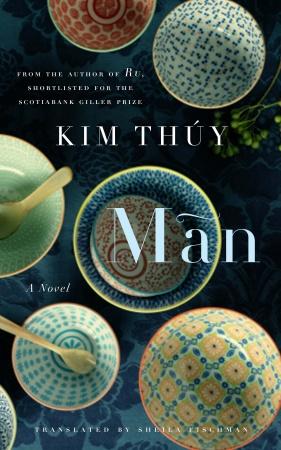
Mãn
by Kim Thúy, translated by Sheila Fischmann
Random House Canada, 2014 (originally published in French in 2013)
139 pages
Here's a thing I don't do often: read a book, and then immediately go out and find whatever I can by the same author and read that too. I did it in this case. And the strange thing is that - I liked Ru. I respected Ru. I didn't think I'd loved it. But perhaps, in some way that my own brain didn't quite clue in to, I did? It helped, too, that Mãn had just come out very recently, and working in a library, I had it to hand immediately.

It's a little hard to hang on to either of these books in specifics, in that they don't have much in the way of characters or plot. But they do have imagery and tone, and somehow Kim Thúy has managed to make those the driving force of Ru, and to a lesser extent Mãn. The latter does have more plot, and significantly more character. This may or may not be a good thing; I liked them both, and originally thought of Mãn as being the stronger, and underrated. But it's Ru that has stuck with me more clearly. Both explore the life of a woman who has come from Vietnam, as a refugee (in Ru) or after the war (in Mãn). The war plays a large role in both these novels, as does the experience of coming to a new country - in this case, Canada - and making a life here.

One of the meanings for the word "ru" is lullaby - Thúy explains this at the beginning of the book. In many ways, Ru struck me as a series of images that might bubble up before sleep. Ru and Mãn don't even really have chapters; they have paragraphs, or sections. Sometimes a section is a line or two long. Sometimes it's three, maybe five pages. I'm not sure there were any sections longer than that. Each is a painstakingly crafted image, memory, or moment, from a first person perspective. The narrator can be a bit dry, or maybe a better way to describe her is "reserved," but one gets the impression that she is always trying to be honest. Some of the sections are connected. Some of them are not, other than they have the same narrator.

Both start fairly slowly, especially because (to me at least) the format can come as a bit of a shock. Because neither book is structured as a typical novel, and without the usual components like a solid, chronological plot or dialogue or conventional characterization to hang on to, one can feel a bit adrift for the first little while. I worried about this, when I started Ru, because it's not a long book. I needn't have worried.

The books - most especially Ru, but Mãn as well, to a lesser extent - unfold like a series of beautiful blossoms, each page or section a memory, hanging off each other like a delicate string of pearls. If you hold them lightly, something wonderful happens. The reader does a lot of the work, filling in blanks. Nothing is explicit. But gradually a picture begins to develop - of Vietnam, of the life of a "displaced" person, of how a person can break apart and slowly be put back together, but never again without scars. Mãn, with its more explicit plot, does a lot more of the work for the reader. Which means that though I think it's stronger in some ways - it gives one more to sink one's teeth into - it also imposes itself on the reader, where Ru almost feels like it comes from within.

Neither one of these books will take you very long to read. And both are worth it. But if you're going to read just one, read Ru. Be prepared to open yourself to it, no matter how slow or odd it seems at first, as a reading experience; you will be rewarded.

Tuesday, October 13, 2015

Fangirl by Rainbow Rowell

I have this little thing, called a blog? And I used to write about books? And then one day I just stopped.

And then one day I just started again. So here we go. Bear with me, I'm incredibly rusty.

Fangirl
by Rainbow Rowell
St. Martin's Griffin, 2013
422 pages

Once upon a long time ago I read a book called Fangirl. It was one of the first books I read this year, in fact. And I loved it. The end.

No no, there's more - and I'm not going to do the book justice, of course, because I read it nearly a year ago, but here's the thing: I read this nearly a year ago, quite quickly, and I still think about it regularly and with a fair amount of clarity. The thing is, it's not just a nice book - and it is, a really nice book, where nice things happen and people are kind and awkward and lovely and maybe sometimes a bit mean but they aren't just awful for no reason. They all have reasons, and they are all sympathetic, even when they are not good reasons. There's no forced love triangle, there's no insta-love, there's no easy answers; there are just good people trying to work their way around being individuals and members of families and friends, which is not always easy and provides enough drama to make an engaging, charming, intelligent book.

More than just being a nice book, Rowell's writing makes the reading of it seem effortless. It's an easy read. It goes down smoothly. It's funny in the right parts, and tense in the right parts, and moving in the right parts. The pacing is absolutely dead on. I was worried that the excerpts from Cath's fanfic would stall things, or be uncomfortable to read (in the way that fiction-within-fiction can sometimes just be... weird) but those excerpts were delightful. I can see why people want to read more Simon Snow.

Me, I'll be reading more Rowell, regardless of whom she's writing about. Thoroughly enjoyed, highly recommended.

Monday, February 2, 2015

Life After Life by Kate Atkinson

Life After Life
by Kate Atkinson
Hachette Audio, 2013
12 discs, unabridged

I'm really glad I chose to listen to this as audio versus reading it. This book tends to be a bit polarizing. People I talk to at the library seem to either love it or dislike it in the extreme, and I will be honest: I thought I'd be in the latter group. The last time I read some sort of critically acclaimed literary novel with some sort of fantasy/sci-fi time-bending twist it didn't really go well. Which is an understatement. So I was prepared for that this time, too. Also, I was pretty unexcited about reading a book where a child/young woman dies all the time - specifically, where the author has thought about all the terrible things that can go wrong, and variations on that theme. As the mother of a young child there are some things I don't really need help feeling anxious about.

This was so different from what I expected, and part of it was the narration. Fenella Woolgar does an astounding job: she's pleasant to listen to, her inflection is perfect and added to my understanding of the story, and I never got tired of listening to her read to me. And because of the way I process audio information, the repetition seemed rhythmic. I think reading it I might have gotten bored with the repetition, but listening to it gave it a lovely sense of overlapping variations, like a fugue.

I imagine most people are familiar with this book and its premise, but in case you are not: Ursula Todd dies a lot. Or she doesn't, really. What happens is that each time she does die - from the moment she dies at birth, the umbilical cord wrapped around her neck, to the times she dies of Spanish Flu, to the times she dies throughout WWII - she starts over again. But Ursula sort of remembers some things, gets a feeling of dread when bad things are about to happen and is thus able to avoid them, is able to change things, is able to try and try again until she gets it right. Some things are harder to get right than others. It takes a long, long time for her to get through the Spanish Flu. It takes a longer time for her to get through WWII.

But as morbid as that sounds, this isn't really a book about death so much as it is a book about life. It's a book about history, and a book about people. The fact that this is a concept book that is so well-rounded makes me understand why it's so successful. The concept is interesting (though don't go into this thinking it will be explained, or that it's a sci-fi or fantasy novel. It's not.) The characters are fleshed-out. The language is lovely. The history - it is so steeped in history without feeling like Atkinson wrote with a textbook beside her, I loved that. The plot is broken into tiny little pieces a lot of the time, and I find that interesting, not frustrating. But of all the things about this book that people might not like, I can see why that in particular is polarizing. In short, I think this book does have the total package: complex, in-depth characterization, interesting setting(s), great writing, and what I thought was an interesting plot.

I loved the little things that changed, or the not-so-little things. I loved that one got the impression that Atkinson could have just kept going. Though I was pleased with the way the 11th disc ended, I wasn't exactly disappointed there was a 12th disc - though I wasn't exactly delighted with the prospect of what I knew was coming. More about the ending at the end of this review, with very mild spoilers.

I found the characters captivating. Ursula herself is an intelligent, practical, only slightly odd protagonist; it is often (though not always) easy to sympathize with her and easy to root for her, to want this time for her to get it right. Atkinson doesn't go into detail with all Ursula's lives, but some of the things Ursula goes through are just brutal (another reason listening was a good choice for me - I didn't chicken out) and as a reader I was almost frantic that she not go down that path the next time.

Further on the characters, I loved how we were allowed to get to know Sylvie, which allows us to have some sympathy for her when she is really unlovable, and how at the very end we see Hugh a bit better and he is a little less wonderful than he was. (And the mental gymnastics this then makes us do.)

Now. The ending. It's hard to say whether there are plot spoilers, but there might be, so if you don't want those, be prepared to stop before the last paragraph. Just know that overall, I was so concerned about where things were going that I was wondering if I would actually end up liking the book. And by the end, I was so impressed that even though I didn't love the ending exactly, I was kind of amazed by the entire book. Books that amaze me are not as common as one might think from my sometimes superlative language when it comes to talking about them. This one left me feeling a little awestruck. Well worth the effort it takes, I'd say, though I think if you're the sort of person who requires an action-packed, linear plot, you'll be too frustrated to get much out of this one. Because really - it's not the ending that matters at all. It's all about the journey, again and again.

Aarti also just recently wrote about the audio version of Life After Life, and had a different experience (though gives lie to my "love it or hate it" thought, too.) Go see!


/begin mild spoilers

The ending: SO INTERESTING. Really. Structurally, the ending ... kind of ... left me speechless? So here's the thing: when Ursula got to the point of killing Hitler, I thought, right. Yes. We knew this was going to happen, it happens in the first paragraph of the book, though I partially spent the entire book trying to forget about that. Because of course Atkinson would go there, and I was disappointed, because why wouldn't you go there - the predicability was disappointing. But then that wasn't the end, though it was the end of that particular life. Atkinson kept going, and I was really relieved that we weren't ending on that note, because the book got interesting again, immediately. And though the ending was confusing and maybe bit off a bit more than it could chew, it was braver than I thought it was going to be in my wildest dreams. I love unfinished business in an ending: this ending was entirely unfinished, and I loved it for trying that.

Saturday, January 24, 2015

three great graphic novels

Daisy Kutter 1: The Last Train
by Kazu Kibuishi
Bolt City Productions, 2012
153 pages

So, I hadn't realized this was re-released. I first started following Kazu Kibuishi online years ago, before Amulet was a thing, by reading his Copper comics. (I've got those in printed form too, now, so that will be reviewed here at some point.) But by the time I realized I was in love with his style and his sensibilities, his first graphic novel, Daisy Kutter, was no longer in print and unavailable anywhere. I was always sad about that because it looked fantastic.

Well, it is. One of my local comic stores supported Kibuishi's Kickstarter to reprint Daisy and I got their last signed copy, which you can imagine made me feel like queen for a day.

It's a steampunk western. Daisy is an ex-con who owns and runs a general store. It's pretty clear she's bored out of her skull by it, but it's a legit living. Her excitement comes from playing poker. So when she loses the store in a high-stakes poker match, she has no choice but to take up the winner's offer to give her the store back - if she participates in one last heist.

There are a few plot holes and the ending wraps up incredibly quickly, but this is the first in (I hope!) a series, and it was extremely enjoyable. Daisy's got depth, as does Tom McKay, the local sherrif who also happens to be Daisy's ex-partner in crime, and ex-partner, period. There are lots of questions to be answered, lots of fleshing out to happen with both characters. The world, while somewhat sketched-in for this first instalment, has a huge amount of promise. Very much looking forward to the next book.


Friends With Boys
by Faith Erin Hicks
First Second, 2012
220 pages

I find it hard to write about this one because all I want to say is LURRRRVE. This is a sweet, funny, quirky, sensitive, wonderfully-drawn coming-of-age graphic novel about a girl who is starting high school after being homeschooled her whole life. She has three older brothers whom she adores, and hasn't really ever felt the need for any friends outside of them. But they've all got their own lives and challenges at school, so she's kind of on her own. Lucky for her, she's not the only one in need of a friend.

What's nice about this is that it's not really deep or difficult, but it's still a portrait of a kid trying to find her place and fit in, while dealing with stuff - some mundane stuff, like dealing her mother's decision to leave the family or her first year at school, and some not at all mundane stuff, like the strange ghost who keeps following her around. Maggie's got challenges but she's competent, and her family (with the notable absence of her mother) is loving and supportive. This makes the book feel safe and a bit gentle, which is sometimes a nice thing in a coming-of-age book about outsiders.

This book is also really funny. The art supports the characters' development in the best way possible. Hicks can express a huge amount about a character just with facial expression and small gestures, and she uses that to full effect. It's an easy-to-follow style, too, meaning this is a great entree into the world of graphic novels. Excellent amounts of geek humour and an affirming message that being "weird" - however one defines it - is okay.


Ms. Marvel Vol. 1: No Normal
by G. Willow Wilson and Adrian Alphona
Marvel, 2014
120 pages

I'm not sure I really need to introduce this book. It's gotten a lot of attention because Ms. Marvel is Kamala, an American-born Muslim teenager of Pakistani decent, who in addition to having to deal with the sudden onset of superpowers and the appearance of a supervillain, has to deal with obnoxious, racist classmates, a fairly traditional family, a diet that forbids bacon, and a curfew. It could have smacked of diversity lip-service, but it was so well-written it didn't.

The book lives up to the hype. There are a lot of things to like here, from the fast-paced plot and the bright, stylized art, to the way it handles what shouldn't be a sensitive issue (Kamala's race and religion) but really is. But what I really appreciated was how realistic the whole thing feels from an emotional perspective, which is not something one can always say when reading superhero comics (or fantasy novels, for that matter.) While the title of the volume is "No Normal" what is refreshing is just how normal Kamala is, right down to the fights she has with her parents when she breaks curfew and is then punished for it. She's got superpowers and she handles their onset in a believable way. She's a teenager and she feels like a teenager.

Also, on a very frivolous note, I dare you to read this one and not fall a little in love with Boris.

Will definitely be following this series.

Wednesday, January 21, 2015

I wrote a little thing...

... for another blog, in which I discuss the top five picture books I'm enjoying reading to smallfry right now. You can go over there and read it if you'd like.